Ed Emshwiller
1925–1990. Video as an electronic vocabulary, bodies in synthetic space, and the cube that became a world.
Ed Emshwiller spent the middle of his career finding out what kind of pictures the electronic signal could make on its own. His work sits at the moment when analog video and nascent computer graphics start to fuse, and he uses that technical edge almost entirely in the service of perception, embodiment, and what he called electronic space. He is also, for this course, a foundational figure: the artist who built the institutional conditions at CalArts that eventually made a class like this one possible.
Video as vocabulary
For Emshwiller, video was not a recording tool. It was a vocabulary — a set of primitives (feedback, signal distortion, layering, synthesized imagery) through which pictures could be made, not captured. The question that runs across the tapes is humanistic rather than technical: what could the electronic image express about inner states, subjective feeling, bodies moving through time?
The gear was always in service of that question. He had come out of 16mm experimental film, and the concerns he carried into video — dance, bodies, the texture of movement — stayed with him. What changed was the compositional palette: now time itself could bend, and space could be built from scratch inside the signal.
WNET and Scape-Mates
In the early 1970s Emshwiller was among the first artists-in-residence at WNET/13's Television Laboratory in New York — the same workshop that hosted Nam June Paik and shaped much of the language of US video art. With video synthesizers and signal processing available at production scale for the first time, he made tapes that pulled the image away from documentary realism: figures moving through electronically constructed landscapes, space modulated by the electronics themselves.
Scape-Mates (1972) is the piece most readers will find first. Dancers move through synthesized environments whose scale and depth shift beneath them; illusion and reality become sliding values rather than fixed categories. The tape reads as a primer for the video-art vocabulary of its decade. Long before standardized 3D packages existed, Emshwiller was using video processing to imply volume, perspective, and spatial traversal.
Sunstone and NYIT
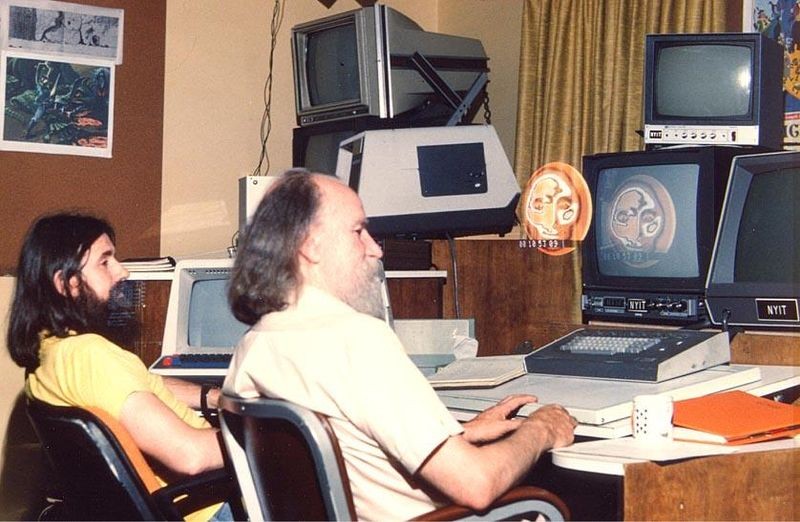
By the late 1970s the question turned from signal processing to computer animation proper. With a Guggenheim grant, Emshwiller proposed a three-hour computer-generated film. NYIT's graphics group, led by Alvy Ray Smith, told him the available hardware would buy him about three minutes in six months. Sunstone (1979) was those three minutes.
At its surface, Sunstone is a rotating cube. Each face carries an image — a sun, a face, an architectural form — that morphs and re-maps as the cube turns. Conceptually, the cube is a metaphor: three-dimensional, temporal electronic space as a kind of figured object, hyperreal and simulated, oscillating between the outer image-world and an inner subjective vision.
The workflow was close artist–engineer collaboration. Alvy Ray Smith's account describes Emshwiller setting visual goals and metaphors while the NYIT team figured out how to realize them within hard constraints of render time and memory. A single frame from the piece ended up on the cover of Fundamentals of Interactive Computer Graphics (Addison-Wesley, 1982) — the tightest possible link between Emshwiller's work and the graphics research culture that produced it.
CalArts and the Computer Animation Lab
After Sunstone, Emshwiller came to CalArts. He founded the Computer Animation Lab and, as dean of Film/Video, institutionalized the hybrid working culture that had made the piece possible: dance, performance, experimental film, and computer imaging sharing the same ecosystem, with artists working in conversation with the engineers and tool-makers around them.
It is the same institutional logic — arcane tool, artist–engineer conversation, shared ecosystem — that this course tries to carry forward. The specific actors and instruments are different now; the shape of the work is not.
Reception and afterlife
Sunstone travelled. SIGGRAPH 1979, WNET's Film/Video Review, the Mill Valley Film Festival, galleries, and eventually museum collections including MoMA's video holdings. Critics and historians reliably tag it as one of the seminal early works of computer animation — in part because it insists on metaphor and perceptual play rather than demo-reel spectacle. Most computer animation of its era was trying to prove the hardware could render realistically. Sunstone was trying to find out what kind of interior world the hardware could make legible.
Where to see the work
- Video Data Bank — distributor; educational and gallery rentals.
- Electronic Arts Intermix — biography and distribution.
- Alvy & Ed (Computer History Museum) — Alvy Ray Smith's first-person account of the NYIT collaboration on Sunstone.
- The Film-Makers' Cooperative — Sunstone print rental.
- Sunstone (1979) on YouTube — a common transfer drawn from distributor/museum copies.
- Anthology Film Archives holds prints and tapes of his 16mm and video work.