John Lasseter
b. 1957. Second student in the first Character Animation cohort at CalArts; his senior film Lady and the Lamp (1979) quietly encoded the ideas about objects-as-characters that would become Luxo Jr., Toy Story, and the early Pixar aesthetic.
John Lasseter is the student most directly responsible for CalArts ending up at the center of late-century American animation. He enrolled in 1975 as the second student in the brand-new Character Animation program, graduated in 1979 with two Student Academy Awards, and went to work at Walt Disney Feature Animation carrying a working theory of animation that turned out to survive the transition from pencil-and-paper to computer graphics. Toy Story (1995), the first fully computer-animated feature, was directed by Lasseter alongside three other CalArts alumni.
CalArts and A113
The Character Animation program Lasseter entered in 1975 was new — created by the Disney veterans Jack Hannah and T. Hee to train a new generation of character animators after the original Nine Old Men had retired. Classes were held in Room A113, which has since become the most-Easter-egged room number in animation history: every Pixar feature and many Disney ones hide A113 somewhere in a prop, license plate, or sign.
Jerry Rees was student #1; Lasseter was #2. The first full cohort also included Brad Bird and Tim Burton. Contemporaries have since called it the class that roared
— the generation that reignited feature animation in the 1980s and 1990s. While studying, Lasseter spent summers working the Jungle Cruise at Disneyland, keeping a direct thread to the studio culture his teachers had come from.
Student films
In his senior year Lasseter made Lady and the Lamp (1979), a short about a small desk lamp and its hotel-lobby environment. The following year he followed it with Nitemare (1980). Both films won Student Academy Awards for Animation. Together they demonstrate what CalArts had given him: cartoon timing, clear staging, strong character reads, and above all a willingness to build personality into things that don't have faces.
Lady and the Lamp as proto-CG
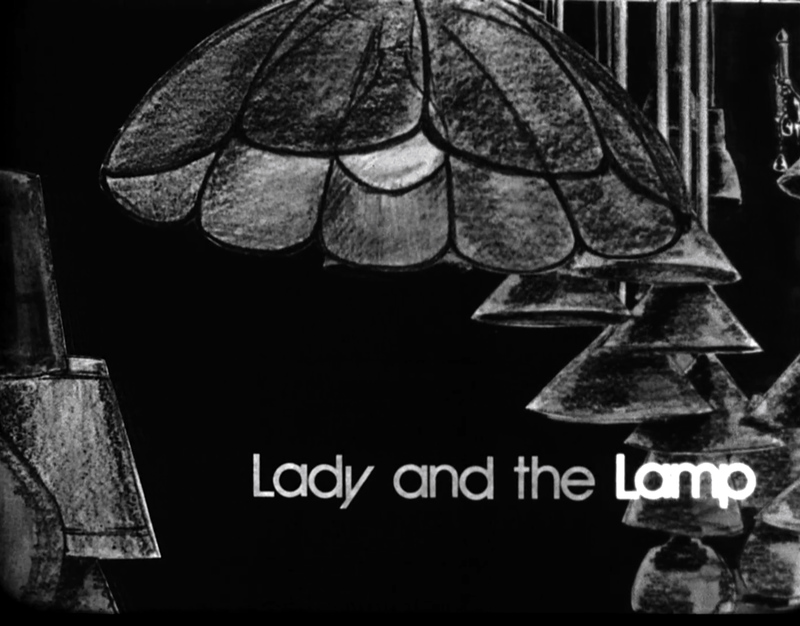
What matters about Lady and the Lamp in this course's lineage isn't that it's technically sophisticated — it's completely hand-drawn, no computer anywhere in the stack. What matters is that it already contains the ideas Lasseter would later use to make the case for computer animation.
The film personifies inanimate objects: a lamp, props on a table, an arrangement that can only be read as characters through shape, timing, and pose. This is exactly the problem computer graphics would face a decade later. How do you make a rigid model feel alive? Lasseter had already solved it, in pencil, on a character with no face. Luxo Jr. (1986), his first CG short at Pixar, is the same trick in a different medium.
The Disney principles of animation — squash and stretch, anticipation, staging, arcs — land differently in Lady and the Lamp because the bodies they're applied to are already cylinders, cones, joints. Lasseter had found a way to treat simple geometric forms as actors under the same physics and posing rules as fleshy characters. When CG arrived, most of its models were exactly that: spheres, cylinders, and rigid joints. His training was already there.
Disney → Lucasfilm → Pixar
Upon graduating in 1979, Lasseter joined Walt Disney Feature Animation as an animator. He championed the idea of computer-generated backgrounds with hand-drawn characters on top — a position that made him a bad fit for late-Nine Old Men Disney, and in early 1984 he was terminated after the Where the Wild Things Are computer-animation test he had been working on was canceled.
He joined Lucasfilm's Computer Graphics Group in October 1984 and met Ed Catmull. When the group was spun off as Pixar in 1986 under new ownership, Lasseter stayed. He directed Luxo Jr. (1986) — the short that proved a desk lamp with no face could be a character — and Tin Toy (1988), which won the first Academy Award for a computer-animated film. Toy Story (1995), which he directed, was the first fully computer-animated feature.
Three of his key collaborators on Toy Story — Andrew Stanton, Pete Docter, and Joe Ranft — were fellow CalArts alumni. The first wave of Pixar features was, in effect, the CalArts Character Animation program showing up in a new medium. In 2014 CalArts awarded Lasseter an honorary doctorate, closing the loop on a training it had begun in 1975.
A note on the through-line
Lasseter is here because his path shows something specific: a technical revolution that looks like a clean break often isn't. Toy Story looks like the beginning of a new medium. It is also the end of a training process that started four decades earlier, in a Disney-veteran-taught classroom at Valencia, applying hand-drawn principles to what turned out to be the same geometric problem computers would later solve. The medium changed. The grammar didn't.
Where to see the work
- Wikipedia — biographical summary and full filmography.
- CalArts blog: Watch John Lasseter's and Andrew Stanton's CalArts student films — includes Lady and the Lamp and Nitemare.
- CalArts 2014 honorary degree announcement — includes Lasseter's own account of the CalArts years.
- Academy of Motion Picture Arts: 20th anniversary of Toy Story — conversation with Lasseter and Catmull.
- Cartoon Brew: Early CGI milestones that led to Toy Story's breakthrough.