Joanna Priestley
The first computer-animated film made at CalArts, a balky Cubicomp, and Jules Engel's instruction to follow the glitches rather than fix them.
Joanna Priestley came into CalArts for an MFA in Experimental Animation and walked into the middle of an experiment — the school's first attempt to figure out what a computer animation lab could be. The instrument at the center of the experiment was a Cubicomp PictureMaker; the teacher at the center was Jules Engel, who had hired her as his TA. The first computer-animated film CalArts ever produced came out of this collaboration: Jade Leaf (1985). What she learned on that Cubicomp — including how to work with a machine whose errors were part of the medium — has shaped her practice ever since.
The first computer animation class
The class ran in 1984–85, taught by Vibeke Sørensen. Only a handful of students and faculty had access to the big, beige Cubicomp the school had just bought. Priestley was already Engel's TA, working closely with him on early computer-animation experiments; the class and that ongoing collaboration fed the same small set of first films.
The Cubicomp setup
The Cubicomp PictureMaker was not a friendly machine. The school had bought it, turned it on, and found themselves staring at a blank screen — they had to bring in a programmer so that creating, saving, and filming images was even possible. Alongside it sat a Compaq PC with about 8 MB of RAM and a 40 MB hard drive. The software was Lumena, Easel, and PC-10.
There was no pipeline from framebuffer to videotape. To record the output, they set up a 16mm Bolex on a tripod in front of the monitor and triggered single-frame exposures via a custom program. Every finished frame was a photograph of a CRT. Priestley worked with the keyboard rather than a tablet or mouse, building abstract compositions of lines and shapes inside the software and stepping through them by hand as each frame was captured.
Following the glitches
The system was unstable. Palette flips, quantization errors, geometric failures, outright crashes — what Priestley has called bizarre problems
with the Cubicomp. Engel's response, by her account, was: Honey! Let's follow that.
Glitches became compositional material. Crashes turned into paths of experimentation. The work grew out of the machine's misbehavior rather than in spite of it.
An unstable tool can be turned into a medium by artists willing to treat its failures as material. The machine has preferences of its own; the work is what happens when those preferences are heard.
The films
Jade Leaf (1985) is the first computer-animated film made at CalArts. An abstract computer painting inspired by botanical forms, generated on the Cubicomp and filmed off the monitor with the Bolex.
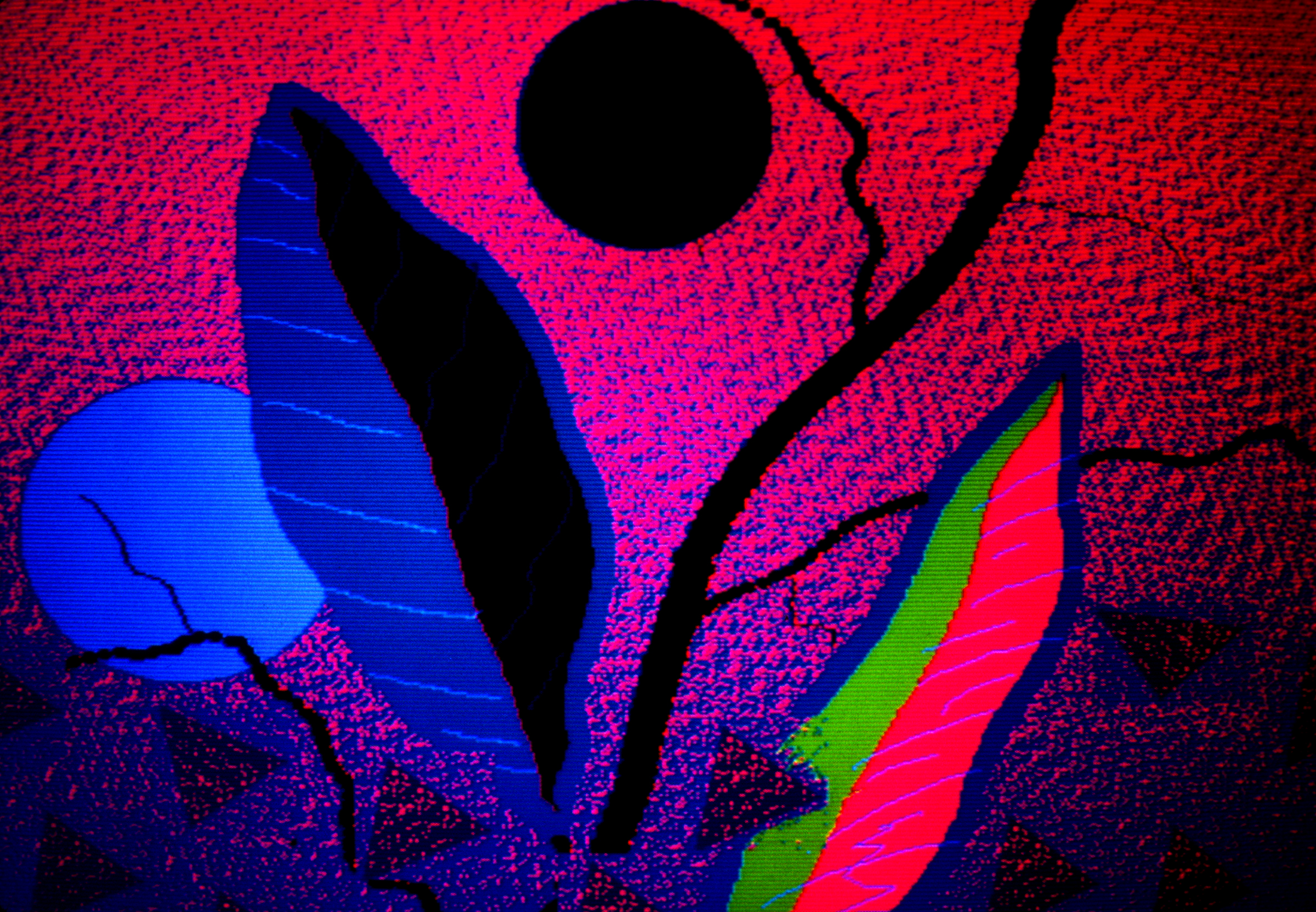
Decanter, co-directed with Engel, is an abstract structural experiment on the same hardware stack — a proof-of-concept that the lab could produce finished work.
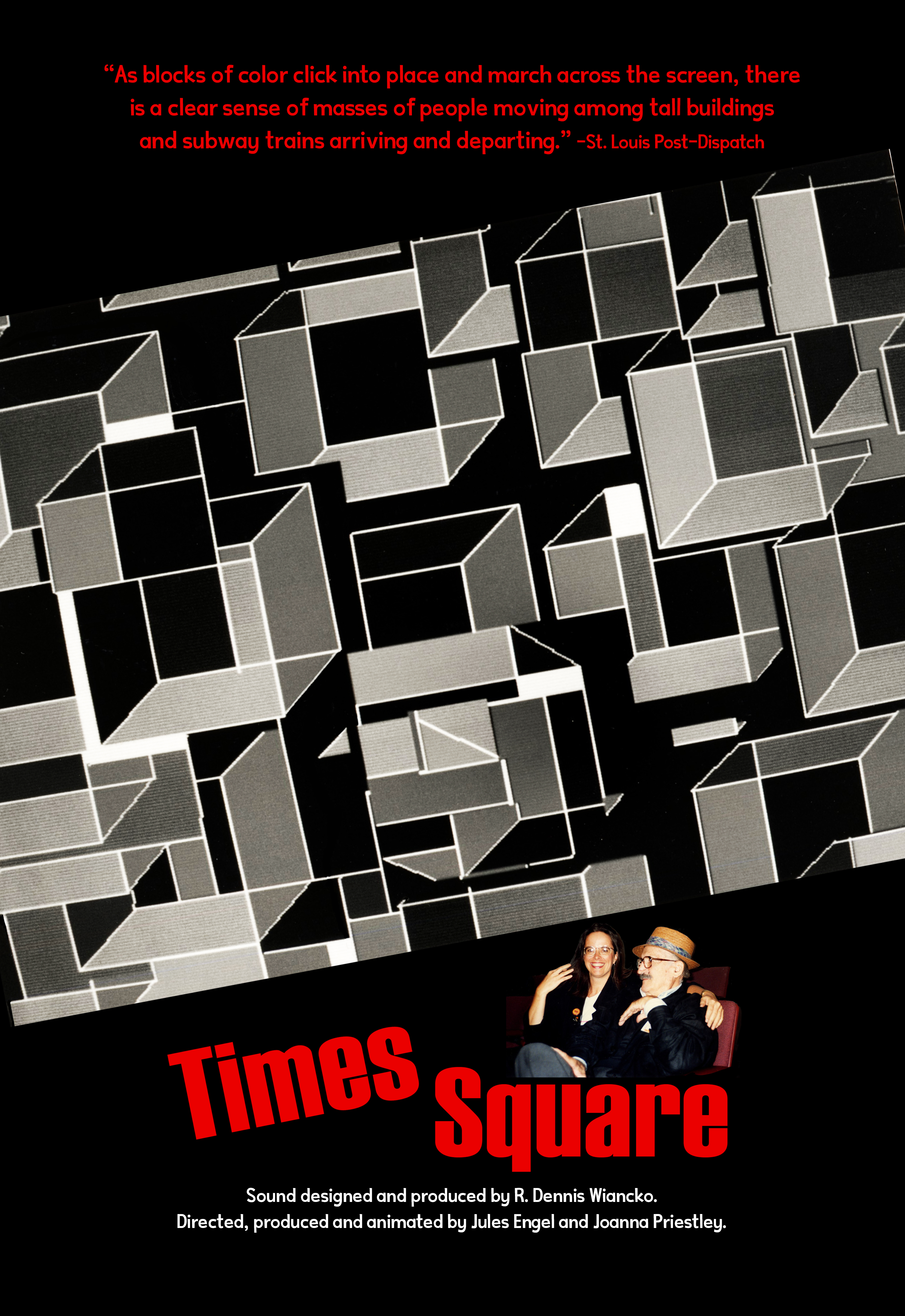
Times Square (1986), again with Engel, is an abstract meditation on urban shapes and sounds, made on the Cubicomp and an IBM AT using the same trio of Lumena, Easel, and PC-10. The film, by Priestley's account, grew partly from the Cubicomp's malfunctions; they were folded into its evolving visual logic rather than repaired.
After CalArts
Priestley has been explicit, in interviews since, that what she took from CalArts was not a dependency on the Cubicomp. When she left the school and lost access to the machine, she went back to her studio and started working with low-tech methods. She reads this as a corrective to the way high-end facilities can paralyze people once they're out of school: the practice travels, not the equipment.
She has since made more than three dozen films across four decades. The Harvard Film Archive now holds the Joanna Priestley Collection.
The pattern — take an arcane, unstable tool seriously, let its errors become material, make the machine's preferences part of the practice — is a pattern this course tries to continue, with a language model instead of a Cubicomp.
Where to see the work
- joannapriestley.com — 36 Films: her own canonical filmography.
- Harvard Film Archive: the Joanna Priestley Collection — prints, tapes, and materials.
- Wikipedia: short biography.
- Skwigly interview: "A Talk With Independent Animator, Joanna Priestley."
- Michael Sporn's Splog: personal notes and images, useful primary material.
- Celebrate CalArts: her entry in the school's oral history.
- LA ACM SIGGRAPH, 1988: Cubicomp (PDF): technical context on the machine.