Jules Engel
1909–2003. Painter, Disney and UPA veteran, founding director of Experimental Animation at CalArts — and the mentor who told his students to confuse him, follow the glitches, and fall on their faces.
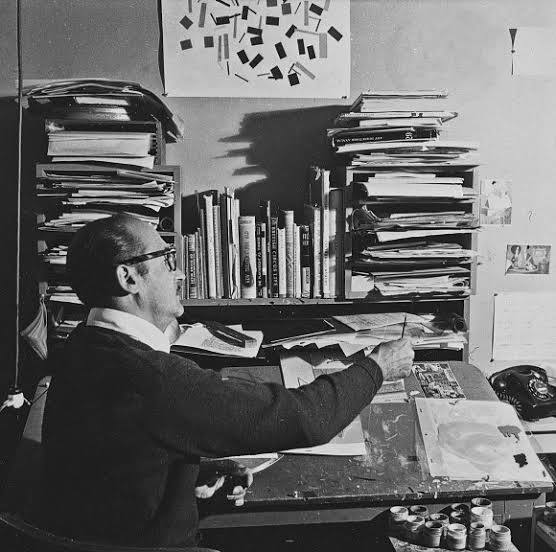
Jules Engel is the through-line. Most of the artists in this Lineage section came through his classroom at CalArts, or through the program he built there, or through the studio culture he installed in it. He was an artist in his own right — a painter, a Disney veteran from the Fantasia era, a UPA background designer — but the reason he matters most to this course is the pedagogy. Engel taught his students to treat new technology as plastic, fallible material for personal research, rather than as a fixed pipeline. That stance, carried forward, helped make the experimental CalArts computer animation of the 1980s possible.
Before CalArts
Engel was born in Budapest in 1909 and came to Los Angeles by way of the mid-twentieth-century Hollywood studio system. He worked at Disney from 1938 to 1941, including choreography on the Nutcracker Suite sequence of Fantasia (1940) and storyboard work on Bambi. From 1944 to 1959 he was at UPA — the progressive postwar animation studio that produced Gerald McBoing-Boing, Madeline, and the Mr. Magoo shorts — first as a background artist and then as art director from 1950.
After UPA he co-founded Format Films in Los Angeles for four years, then spent four more in Paris as a director and designer. His own films Icarus Montgolfier Wright (1962, Academy Award nominee) and Coaraze (1965, Prix Jean Vigo) belong to this period. The range of institutional experience — major studio, progressive studio, independent production, international solo work — was already behind him by the time he took the CalArts job.
Founding Experimental Animation
In 1969 Engel came to the brand-new California Institute of the Arts and founded its Animation Program. He remained there until his death in 2003 — thirty-four years in the same room. Partway through that tenure he founded and ran the Experimental Animation Department as its own thing, separate from the mainstream character-animation program: a dedicated home for abstract, non-narrative, and cross-media work that refused to treat those forms as secondary to commercial animation.
This is the program Adam Beckett and Joanna Priestley came through. It is the institutional condition that made the whole lineage assembled on these pages possible.
The pedagogy: “Let's follow that.”
Engel defined himself as a mentor, not a trainer. His job, as he understood it, was to protect and amplify each student's idiosyncratic vision, not to push them toward a house style. He explicitly wanted to be confused by student work; when he couldn't quite read a piece, he took it as a sign the student might be onto something new.
In practice this meant that he did not grade on polish. He valued risk, surprise, and, in his phrase, falling on your face as necessary steps, then pushed students to get up and keep pushing. When Priestley's Cubicomp crashed, produced strange palette shifts, or rendered quantization errors, Engel's response was the now-famous Honey! Let's follow that.
Glitches became compositional material. Accidents became the work.
The studio itself was part of the teaching. Student work went on the walls. Equipment was shared across generations. Early computer animators were constantly looking at paintings, drawings, collages, optical-printer films made by peers and predecessors. The computer sat in the middle of all of that, as one material among many rather than a special category.
The through-line in his students
Engel's pedagogy shows up differently across the artists on these pages, but the pattern holds. Adam Beckett absorbed his emphasis on open-ended experiment and turned the optical printer into a primary drawing instrument — running tiny cycles of drawings through hundreds of passes, letting complexity and excess become the point. Joanna Priestley walked into the first computer animation class already oriented to Engel's non-narrative abstraction, and used the Cubicomp for painterly botanical and geometric experiments rather than commercial graphics; when the machine misbehaved, she folded the misbehavior into Jade Leaf, Decanter, and Times Square.
Later CalArts animators who went into feature animation and visual effects — John Lasseter, Tim Burton, Henry Selick, Stephen Hillenburg, Glen Keane — carried a subtler version of the same attitude into commercial studios. The Disney and UPA lineage Engel brought to CalArts came back out through them into late-century mainstream animation.
His own work
Alongside the teaching, Engel kept making. His own films belong to the visual-music tradition — abstract, rhythm-driven, close in sensibility to Fischinger, though the color sense and compositional language are his own. Shapes and Gestures (1976) is probably the most widely seen of his short films. He painted throughout his life; the Center for Visual Music holds his films and related papers. The Winsor McCay Award came in 1995.
A note on the through-line
When this course treats a language model as a collaborator with preferences rather than a service that delivers answers, it is practicing a version of what Engel taught. Follow the medium's strangeness. Confuse yourself. Keep the glitches. The machine — any machine — is interesting exactly to the degree that the artist lets its misbehavior count as information.
Where to see the work
- Wikipedia — biographical summary with filmography and awards.
- Center for Visual Music — Jules Engel, Post Modernist. The main archival home for his films and papers.
- Animation World Network: “Remembering Jules Engel — Teaching Visual Music.”
- Animation World Network: “Jules Engel: The Mentor.”
- LA Times, 1995: “An Animated Personal Vision.”
- Vanity Fair, 2014: The CalArts Class of the Renaissance — the late-century mainstream-animation side of his legacy.
- Visualizing Art History: Experimental Animation and Its Mentor, Jules Engel — the most substantial academic essay on his pedagogy.