Adam Beckett
1950–1979. Turning the optical printer from a post-production tool into a primary image-making machine — simple drawn loops compounded, pass after pass, into cosmic abstractions.
Adam Beckett had about nine years as a working animator before he died, and in that short window he produced a body of films that made the optical printer look like a computer before computers had arrived at the party. His CalArts cohort was the first experimental animation class the school ever ran. His teachers were Jules Engel, Pat O'Neill, Gene Youngblood, and — in a video course — Nam June Paik with Shuya Abe. What he took from that ecosystem was a different question about what a machine in the image-making pipeline is actually for.
The first CalArts cohort
Beckett attended CalArts from 1970 to 1975 as part of the first Experimental Animation class the school ran. His classmates included Kathy Rose and Sky David. The teachers in the room were already rewriting what an animation pedagogy could be: Jules Engel for animation proper; Pat O'Neill for optical printing; Gene Youngblood running a seminar that became the book Expanded Cinema; and a video course taught by Nam June Paik and Shuya Abe.
Youngblood's framework treated the machine as a site for perception-altering transformation, not just a substrate for content. O'Neill's own printer experiments gave that framework a hands-on demonstration. Beckett absorbed both into what became a process-driven practice — not character animation, not story animation, but the production of images through the patient traversal of mechanical operations.
The printer as primary tool
An optical printer, in the pipeline most animators knew, was a post-production machine. It handled titles, fades, simple composites — everything that wasn't the drawn animation itself. Beckett reversed the relationship. He used the printer to the extreme, as a production tool for primary imagery, passing his own footage through it hundreds of times. The finished film was less the drawn loop than what the printer had done to it.
The workflow
The starting point was small. A simple drawn cycle — often well under twenty drawings — photographed on the animation stand. Nothing unusual yet. What followed was: take that film into the optical printer, layer it against itself, zoom it, rotate it, re-expose, re-frame, matte portions out and fill them on a later pass. Do that again. And again.
Pamela Turner, who has written the definitive research on Beckett, describes the practice as treating printer passes as a compositional calculus: each pass is a discrete operation applied to the current image state, and the film is the accumulated output of that calculus. Simple input, recursive transformation, dense result. Accounts from collaborators describe him spending days in a dark room at the CalArts printer, doing up to two hundred passes on a single piece of film.
The films
Evolution of the Red Star, Heavy-Light, Flesh Flows, and Kitsch in Synch are the four preserved by the Academy Film Archive, and the three most readers will find first are the first three. Each turns relatively minimal line or shape sequences into something that resembles cosmic abstraction — light patterns that look uncannily like video feedback or early computer graphics, but are drawn and optically printed, with nothing digital in the stack.
Heavy-Light is often named the apex of Beckett's printer mastery. A cycle of just thirteen drawings generates the entire film; what fills the runtime is what the printer did with those thirteen drawings. Forms dart, swirl, engulf the frame, and dissolve into new ones, all from the same small set of originals.
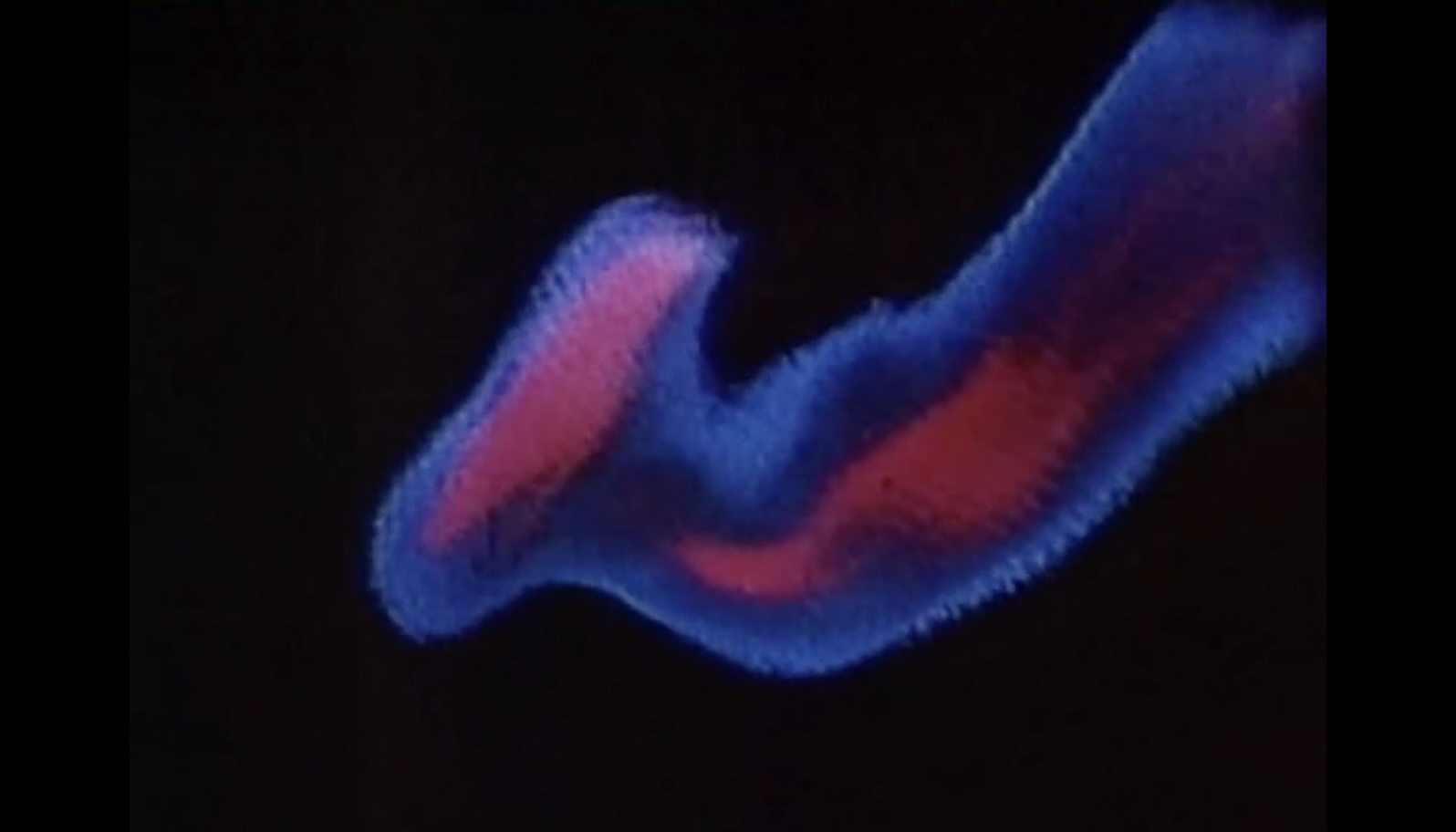
Dear Janice does the same trick against a different surface. Beckett stitches live-action horizons into spiraling hand-drawn fields so that the photographed world appears embedded inside his animated universe. The printer is the seam between the two.
After CalArts
Shortly after graduating, Beckett joined Industrial Light & Magic as head of animation and rotoscoping on Star Wars. CalArts optical-printing culture was thereby exported, through one student, into the moment Hollywood visual effects was being rewritten.
He died in a house fire in Val Verde, California in 1979, at twenty-nine, cutting short a career that had barely begun. His influence at CalArts itself was already visible — David Wilson's Stasis and Dead Reckoning inherit the structural-optical approach, where the event of the film is the gradual change of an image through printer operations. Preservation writing since has tagged Beckett's combination of obsessive drawing and printer extrapolation as a set of techniques still echoed in contemporary effects and independent animation work.
Some of the resemblance between his films and the output of feedback shaders today is not an accident. The conceptual move — a simple input, a recursive transformation, a dense image — is the same move, executed by hand and light instead of by code and GPU.
Where to see the work
- The iotaCenter and the Adam K. Beckett Project — preservation effort; the most serious source for restored prints and transfers.
- Pamela Turner's research — the definitive academic study of Beckett's process and films.
- Animafest: Flesh Flows — festival page with context.
- LA Times tribute — "Tribute to an animator's life," 2009.
- Lapsed Time Images: Adam Beckett, Infinite Animator — good short piece on his practice.
- Preservation Insanity — writeup of five films from 1973–75.
- Wikipedia — short biographical entry with links to Academy Film Archive holdings.