Pat O'Neill
b. 1939. Optical-printer compositing as the precursor to digital layer-and-node thinking. Water and Power (1989) and the decade-long making of a layered mural of Southern California water.
Pat O'Neill has spent six decades making films and objects in Los Angeles. He is the experimental filmmaker whose work most visibly anticipates contemporary digital compositing — layered landscapes, hand-built mattes, temporal and spatial collage all built pass by pass on the optical printer before digital compositing had a formal name. He was also a founding faculty member of the CalArts School of Film/Video, where he taught Adam Beckett, Robert Blalack, Chris Casady, Larry Cuba, and two generations of students who carried optical-printer thinking straight into the digital era.
Before CalArts
O'Neill was born in Los Angeles in 1939 and studied at UCLA, where he was among the first Americans to receive a graduate degree in moving-image art. From the 1960s he worked as both an experimental filmmaker and a commercial optical-effects artist, using the camera as what he has called a gathering device
for oil derricks, nudes, urban and desert landscapes, and then recomposing the raw footage through re-photography on the optical printer. 7362 (1967) is the earliest of his frequently-screened films; the layered transparencies and interpenetrating silhouettes that became his signature are already there.
Water and Power (1989)
Water and Power is the film most readers will find first. A 35mm experimental feature, about fifty-five minutes long, made over roughly a decade and released in 1989. O'Neill describes it as metaphorically about the exchange of energy between two places
— Owens Valley, a major source of Los Angeles's imported water, and downtown LA itself. The film moves between the two using time-lapse, stop-motion, multiple exposures, motion-controlled tracking shots, animation, and optical-printer composites. Found footage from older films and soundtracks is folded into contemporary shots so that past cinematic landscapes become continuous with the present-day ones.
It works simultaneously as a city symphony and as environmental critique: a meditation on Los Angeles's foundation myths, its dependence on distant resources, and the desertification left behind in Owens Valley. It won the Documentary Grand Jury Prize at the 1990 Sundance Film Festival — a rare mainstream recognition for an experimental film — and was added to the Library of Congress's National Film Registry in 2009.
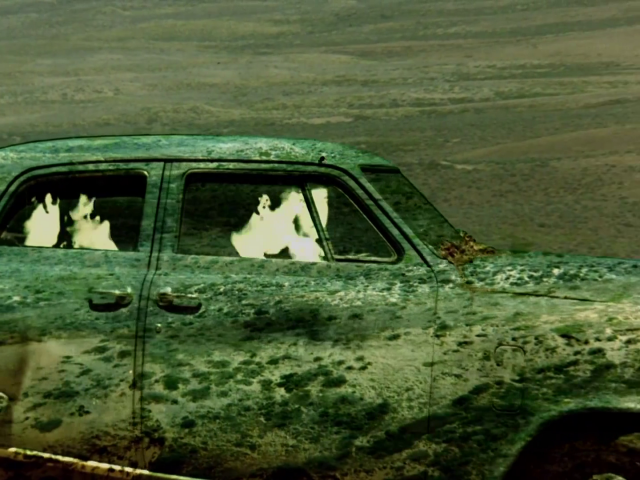
The printer as primary tool
O'Neill's workflow was printer-first. He photographed elements separately — time-lapse skies, industrial structures, performers, found footage — and then combined them frame by frame on the optical printer into dense, semi-transparent, interpenetrating composites. Hand-built mattes and traveling alphas carved out regions of the frame that could carry different images. Each pass was both an operation (scale, re-expose, color-shift) and a layer, dependent on whatever had been laid down before it.
Passes as layers and nodes
This is where O'Neill's work maps most cleanly into present-day practice. Optical-printer composites already function as layer stacks and node graphs. Each pass implements what in software would later be called A over B, or premultiplied alpha, or linear compositing. The innovation digital imaging added was per-pixel alpha and re-routable diagrams — formalization and editability rather than a new way of seeing. O'Neill was working those same structures out physically, with film and light.
A shot breakdown for a complex O'Neill frame reads as a flow diagram: which element goes where, through which matte, in what order. A node graph in Nuke or After Effects is a representation change, not a conceptual break. The first generation of digital compositors, in fact, described what they were building as digital optical printers
, and the most cited history of digital compositing (Alvy Ray Smith's Alpha and the History of Digital Compositing) frames the new software as the implementation of techniques first worked out in optical rooms like O'Neill's.
At CalArts
O'Neill was a founding faculty member of the CalArts School of Film/Video in the early 1970s. Among his optical-printing students were Adam Beckett, who extended printer work into abstract cycles of hundreds of passes; Robert Blalack and Chris Casady, who went from the CalArts printer room into Industrial Light & Magic to do effects work on Star Wars; and Larry Cuba, whose early computer animation for the same film used the same layered, abstract sensibility. The printer room at CalArts became, under his teaching, a site of research rather than service — a place to figure out what could be built by stacking light on light.
His teaching sat alongside Jules Engel's Experimental Animation program and Ed Emshwiller's computer animation work, giving CalArts a uniquely optical and compositional take on moving-image experimentation that later inflected the school's approach to video and computer graphics.
A note on the through-line
The conceptual habit O'Neill taught — treat the image as a stack of operations, plan in dependencies, build complexity by composition rather than by detail — is a habit this course rediscovers every time a student chains shader passes, blends signed distance fields, or composes image effects on top of one another. Different medium. Same grammar.
Where to see the work
- Wikipedia — biographical entry with filmography.
- Alternative Projections — the most detailed archival source on his films and practice.
- Water and Power on Wikipedia — production history and citations.
- Whitney Museum collection: Water and Power.
- Tate Modern: Where the Chocolate Mountains — retrospective programming notes.
- Mitchell-Innes & Nash — his gallery representation; drawings and objects.
- Amherst Cinema: Troubling the Image — four-film program notes.
- Alvy Ray Smith: Alpha and the History of Digital Compositing (PDF) — the canonical technical history, in which O'Neill's optical tradition is the ancestor.